
How to Handle Rejection 👎 as a New Voice Actor
If you can’t stomach rejection, voice acting isn’t for you. And that’s exactly why you should stay.
If you’re losing sleep agonizing over yet another no or radio silence after an audition, listen up. Every working voice actor knows rejection isn’t a bug. It’s a feature. Being a pro voice actor doesn’t mean avoiding rejection; it means accepting it, shaking it off, and booking the next gig.
The resolve to keep going is what differentiates the player from the paid professional.
In this post, I’ll break down the myth that rejection is a price only the untalented pay, and show you step-by-step, how it can actually mold your future success if you let it.
The Numbers ARE Brutal But Not Personal
Let’s start with what nobody wants to admit: even elite voice actors, the folks whose voices you hear on national campaigns, Netflix, or your favorite video games almost never break a 5% booking rate. Many book closer to three out of one hundred auditions.
If you’re new, it’s lower, often less that 1%.
In the world of email marketing, 90% of your outreach won’t even get a “thanks, but no thanks."
Most reputable agents won’t dignify your demo submission with a response unless they’re interested.
But hear me when I tell you…
Rejection is not feedback on your talent. It is a statistical inevitability in a saturated market.
The real professionals, the ones who make it, know the outcome says nothing about their worth or potential.
The No-Response Zone
You poured your soul into a read. You hit send. Then… not a goddamned thing. Not even a “thanks for your time.”
This is not an exception; it’s the rule. For all auditions you submit, 95%+, will end in silence. Understanding that the silence is standard, not a slight, is your first mindset shift toward resilience.
Why Overnight VO Success Stories Are Dangerous Lies
The Real Stories Behind the Overnight Stars
“I booked my first six-figure gig in my first month!” It makes for a flashy YouTube thumbnail but glosses over hundreds, if not thousands of ignored auditions, constant script practice, and unglamorous self-promotion. Almost every “overnight success” you see is standing on a mountain of rejections that never made it to Instagram.
Scrolling social media can poison your mindset. You see bookings, agent signings, new gear setups, and collaboration announcements. What you don’t see is the pile of polite “not quite the fit” emails, or the anxiety after a dry spell.
Don’t confuse someone’s highlight reel for their daily grind.
Rejection Is just Data, Not CONDEmnation
Every no, every unreturned email, is a piece of information. Did your audition match the spec? Was your audio quality up to par? Did your marketing message connect and resonate, or was it off-target?
Rejection isn’t meant to beat the shit out of you; it’s meant to teach.
Audit your approach, not your identity.
Listen back to your auditions.
Compare your read with the brief.
Adjust your marketing message based on open and reply rates.
The most successful voice actors treat their business like scientists with a lab notebook: record results, learn, iterate. Treating rejection as feedback accelerates improvement and growth.
Building Your Rejection Resilience
Step 1: reframe the Rejection
Start by saying out loud: “I will be rejected at least 95% of the time this year, and that’s absolutely normal.”
It’s not a symptom of failure; it’s a metric of progress. The more you audition, the more opportunity you have to book. The more outreach you send, the more conversations you will start, and the more work you will book.
Forget the nos. Focus on the yesses.
Step 2: Set Process Goals, Not Outcome Goals
Instead of “I want to book 10 gigs this month,” shift to “I will submit 40 targeted auditions” or “reach out to 500 new contacts. “ Process goals are fully within your control and create momentum in the face of rejection.
Step 3: Practice the 30 Second Recovery Rule
Give yourself 30 seconds to feel the sting of a no, then immediately shift focus:
what did I learn,
how do I improve,
what’s next?
By limiting/compressing (see what I did there?) your wallow time, you stay eyes forward.
Step 4: Build Community—Share Failures and Wins
Rejection becomes bearable when it’s normalized among peers. Private VO business groups like VO Pro, mastermind sessions, or even one-on-one check-ins with another voice actor can help you realize you’re not walking this path alone.
Working Through the Emotional BAGGAge
The email that doesn’t come. The role you were sure was yours. Each rejection can trigger feelings of worthlessness, imposter syndrome, or anger. If you’re serious about going full-time, you must learn to ride these waves without getting pulled under.
Acknowledge the feeling. Don’t suppress it, name it.
Remember the stats. Even the best book just a handful out of hundreds.
Lean into growth, not perfection. Each no sharpens your audition accuracy, technical quality, and business savvy.
Tools for Mindset Mastery
Rejection Journal: Note what you tried, what happened, and how you responded emotionally.
Affirmations for Resilience: “My booking ratio is not my value. Every audition is a step up.”
VO Mindset Training: Invest in programs/coaching aimed at developing a rejection-proof mindset, like our own Mindset Mastery training.
Turning Rejection into Audition Success
Pick your last five rejections. What patterns emerge? Did you rush the script analysis, fail to address a client’s need, or send a shitty email? Treat these as experiments.
Sample Action: If you’re new, after every ten auditions, review your reads and scoring. Change one variable. Shift your vocal approach, change up your follow-up email style, and track which changes increase your booking or engagement rate.
When you’re not booking, it can mean misalignment, not with your talent, but with your approach. Try this:
Before sending: Double-check you nailed the spec in your audition (and did something different on Take 2).
After sending: Note the details like tone, pacing, script notes.
Upon no or silence: Review briefly. Was it a technical hiccup? Did you misread the specs or demographic the client wanted to target? Your debrief is gold. Don’t skip it.
Surviving the 90% No Response Rate
Understand: sending 100 cold emails and getting ten responses is fan-fucking-tastic. Getting one conversion (and never right away)? Amazing!
Your job is to build systems that make follow-up and nos less personal.
Sample System:
Track opens, replies, interested but not now, and ghosted leads.
Tweak subject lines, signature, demo inclusions every 500 emails.
Celebrate replies, but celebrate finishing your process even more.
No response does not mean no. It means not yet.
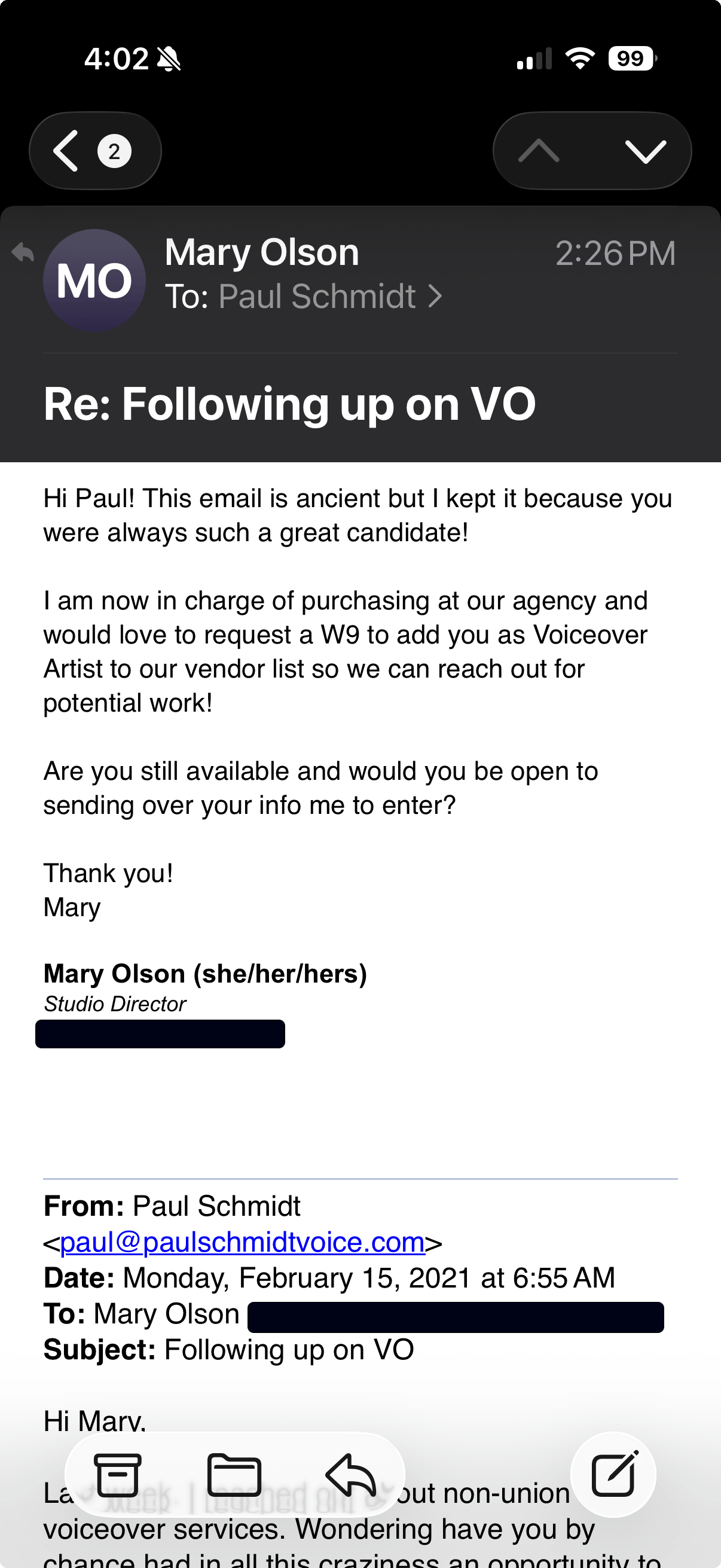
Many bookings are silent until, months (sometimes years later), a client recalls your audition because of your persistence. Your voice might not be right today, but if you remain on their radar, you become top-of-mind when it is.
Case in point, at the right (or above/below on mobile) is an email I got just this week:
If you do the math, you’ll see the prospect got back to me with a positive reply 4 years and 360 days after I reached out!
Why Rejection Fuels Sustainable Voiceover Careers
Thick Skin = Longevity
It’s not the most talented voice actors who persist, but the most adaptable. Those who treat rejection as simply today’s data point stay in the game long enough to hear yes more often.
When you treat your voice acting as a full-fledged business with systems, resilience, marketing strategies, and continuous learning, you separate your self-worth from your booking ratio.
You’re not a rejected artist; you’re a professional in a numbers game. You market. You audition. You refine. You repeat.
Turning Rejection Into Revenue
Invest in Business Coaching
Strategic business coaching like the programs here at vopro.pro helps you analyze your workflow, set up robust systems, and leverage the mindset mastery needed to thrive through rejection.
Upgrade Your Mindset Repeatedly
Attend mindset mastery webinars.
Practice daily mental fitness: visualization, affirmation, and gratitude.
Seek feedback: Not all rejection is meaningless; sometimes, direct feedback (when given) points the fastest route to leveling up.
Embracing Rejection Is A Superpower
Working pros are surrounded by nos and unanswered emails. What sets you apart isn’t magical ability. It’s your resilience and your willingness to treat every non-booking as a step closer to your next big yes.
If you want to make voice acting your career, not your side hustle, build that thick skin for rejection, not by ignoring the sting, but by embracing it, learning from it, and always staying in the arena one audition, one more new contact at a time.
If you’re ready for a roadmap that demystifies rejection and accelerates your growth. from your first cold email to your 1000th audition, consider investing in business coaching and mindset training designed for voice actors like you.
As my dear, ridiculously talented friend, Emma O’Neill says, it’s not rejection. It’s lack of selection right now.
And you can handle that.