How To Run Your VO Business: A Strategic Framework
Picture a Monday morning: two voice actors (or really any two creative pros)
One opens 11 browser tabs, starts with the email inbox as a proxy for a to-do list, gets distracted by LinkedIn article about demos, reads that, goes down that rabbit hole for 35 minutes, starts to write a marketing sequence, but the drier has finished so they fold the laundry before it wrinkles, comes back and completely forgets about the marketing emails because there’s an incoming audition, does the audition, realizes their hard drive is disorganized and spends an hour redoing that, and boom, it’s the end of the workday.
Insanely busy all day. And insanely unproductive.
The other voice actor sits down on the same Monday morning, opens ONLY their calendar, sees exactly what the important items are already time blocked for the week, reviews what other important tasks there are that are also urgent this week, time-blocks those in the available slots, and gets to work, always knowing exactly what to do, when to do it, and that the way they are spending their time and effort is in complete alignment with their business strategy and goals.
So, which one are you?
The busy bee flitting from flower to flower?
Or the strategic CEO-of-one staying on-strategy and on-task, always moving in the direction of their goals?
One is highly reactive to whatever squirrel runs across the road. Putting out fires. Lost in sea of distractions and urgencies, and never getting to the important stuff that grows the business.
The other is highly proactive, focused, relaxed, and in complete strategic alignment.
You either run your day or your day runs you.
The difference isn’t hustle and effort. The difference is structure.
In this video I’m going to give you a complete framework for running your business, aligning your time and effort to your strategic goals, and turning work into actual progress rather than random activity.
Because when you understand this framework and actually execute on it, your time stops being a random mess of activity and starts becoming a strategic business growth engine.
The VO Pro Strategic Execution Hierarchy:
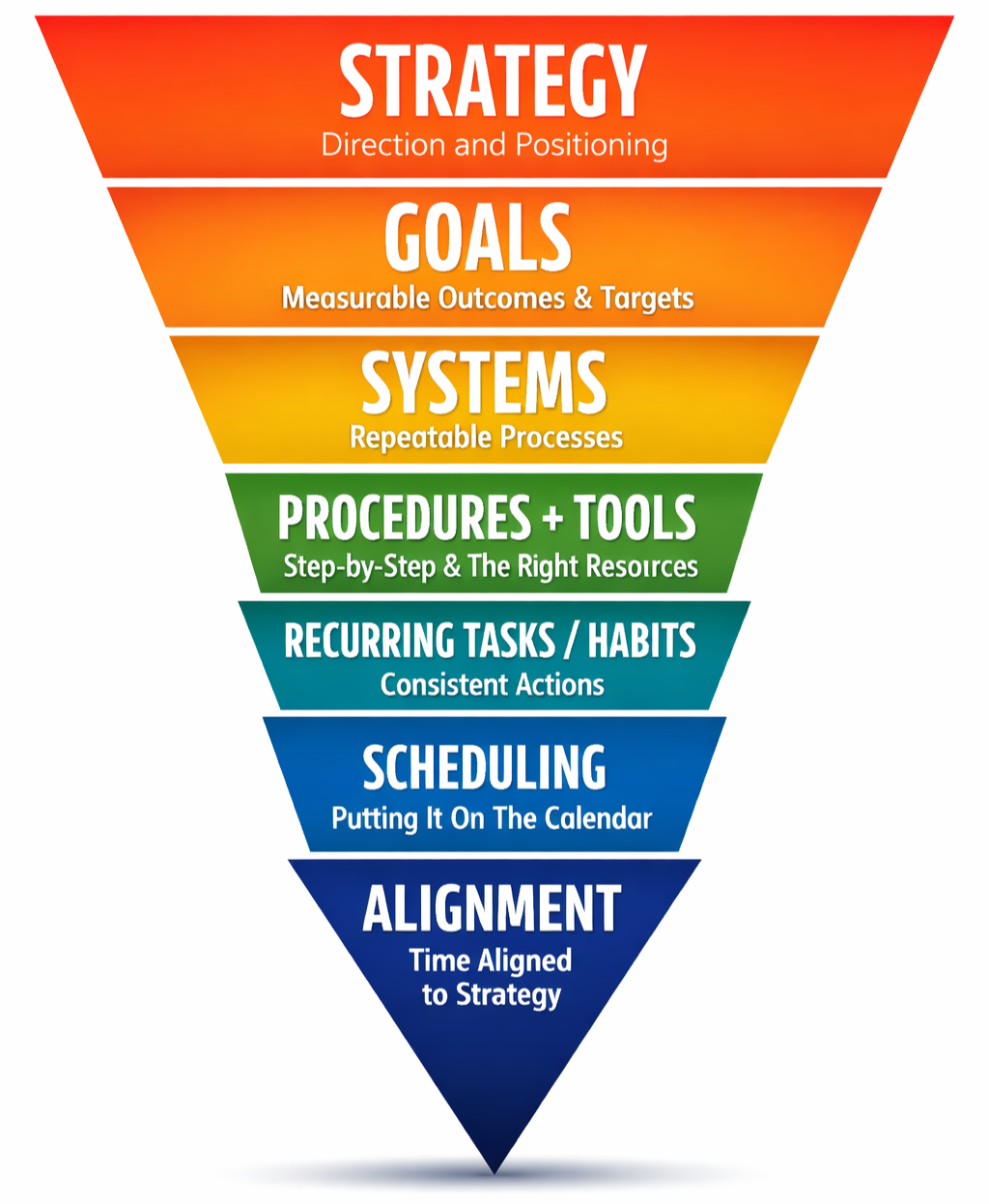
Strategy…
creates your Goals…
which are executed through Systems…
which consist of Standard Operating Procedures and Tools…
which generate Recurring Tasks and Habits…
which are Scheduled…
which ensures your time Aligns with your Strategy.
Most creative business owners start at the task layer. They start with the calendar. What’s due today? What did I forget? What is on fire?
The problem is, because they haven’t started with strategy, they calendar is a collection of grease fires rather than strategic priorities.
When you build from the top down, your whole business changes.
Let’s break it down and walk through each.
Strategy
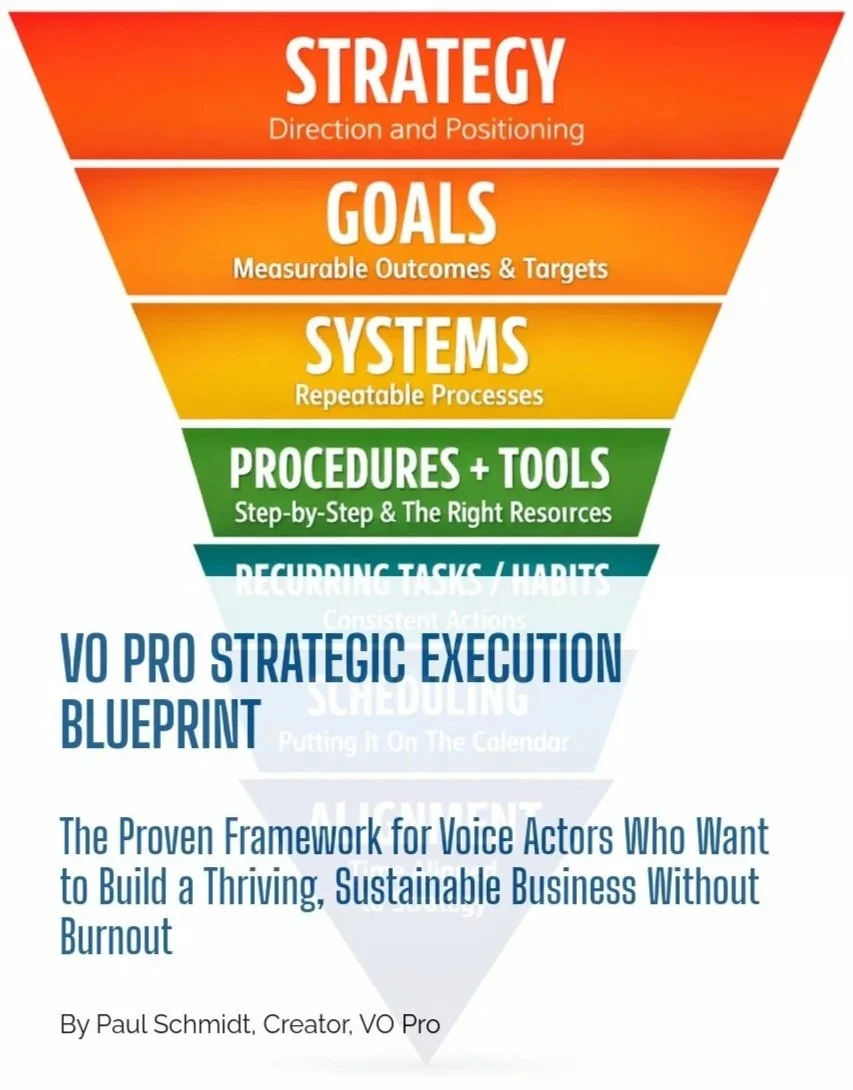
Get the FREE Strategic Execution Blueprint now. Click the image above.
Strategy is not a to do list. Strategy is the answer to a deeper question:
In what direction are you going with your business, and how do you intend to get there?
Strategy shapes direction, positioning, market focus, business model, and growth path.
For example, two voice actors can both want more clients, but their strategies might be wildly different.
One might be, “I am positioning myself as a go to narrator for corporate training and explainer content, building long term relationships with production companies that produce high volume work.”
Another, “I am building a premium personal brand around high-touch commercial voiceover, focusing on agencies and boutique creative shops that value grounded reads, nuance, and unexpected choices.”
Same industry. Completely different strategic direction.
Strategy gives you clarity on:
Who you serve.
Where opportunities come from.
What type of life you are building toward.
What you will say Yes to.
What you will intentionally say Hell No to.
Without strategy, everything looks and feels important. With strategy, most things don’t.
And from your strategy, we derive your goals.
Goals
Turning strategy into measurable outcomes
Goals answer the question: “If my strategy is working, what should start becoming true in my business?”
Goals are specific, observable, and time-bound.
For example:
Sign three new recurring eLearning or corporate narration clients in the next six months.
Generate 20 qualified leads per month through direct outreach by the end of the year.
·Raise my average project value by 15 percent across my top three clients.
Goals aren’t vibes. Goals are proof.
If strategy is the direction or compass, goals are the mile markers.
But goals alone are not enough. Everyone has goals. Most people stop here.
They create goals, feel good about them, maybe even write them on a whiteboard. Then they go right back to doing the same old random shit.
Because goals don’t create progress. Systems do.
Systems
The engines that achieve goals
A system is not a tool. It’s not Zapier or a CRM or a spreadsheet.
A system is a repeatable process designed to consistently produce a specific result.
If your goal is to book more direct clients, your system might include:
Researching prospects.
Collecting contact data.
Sending outbound emails.
Tracking responses.
Following up.
Building relationships over time.
If your goal is to improve retention with current clients, your system might include:
Quarterly emails to keep you top-of-mind.
After-delivery follow-up.
Project debriefs.
Client notes and preferences.
Systems translate goals into processes.
Instead of “I hope I find clients this month,” it’s “I run my outreach system daily, and my pipeline consistently grows as a result.”
Each system contains two key components….
Procedures and Tools
The Building Blocks of Systems
Procedures are the step-by-step instructions for how the system operates.
For example, if your system is Direct Outreach, your procedures might include how you:
Research a company.
Evaluate whether they are a fit.
Find the right contact.
Write and personalize the email.
Log the outreach into your CRM.
Follow up if they do not respond.
Track replies, opens, clicks, and outcomes.
Procedures remove decision fatigue. You no longer reinvent the wheel every time you do the work. You simply follow the process you already designed.
Then we pair procedures with tools.
Tools are what you use to execute the procedures. Email platform. CRM. Spreadsheets. Templates. File management. Editing software. Calendar. Task manager.
Tools support execution, but tools are not the system. A shiny tool without a defined procedure is just clutter.
Once your procedures and tools are in place, something powerful happens.
They naturally produce…
Recurring Tasks and Habits
The actions that keep systems moving forward
Recurring tasks are the actions that must happen regularly for the system to function.
For example:
Prospect research every week.
Outreach blocks daily.
CRM updates after every contact.
Quarterly check ins with existing clients.
Auditions and production of paid work daily.
Content posting schedule if social media is part of your strategy.
Financial review at month end.
File archiving and organization weekly.
Recurring tasks become consistent habits over time. And habits are what separate businesses that grow from businesses that stall.
Because established habits remove willpower from the equation.
When something is a habit, it doesn’t depend on motivation, mood, or inspiration. It just gets done. Like brushing your teeth.
But here is where most people fall apart: They know the tasks. They know the habits. They even agree they are important.
They just never schedule them.
Scheduling
Where intention becomes reality
I’ve said it a hundred times to my students: If it’s not on your calendar, it does not exist!
Scheduling is where everything we’ve built finally turns into reality. Where recurring tasks move from theory to execution. Where your days stop being “what I’ll do when I have time” and become “this is what my time is for.”
When you schedule properly:
Outbound outreach actually happens.
Marketing work doesn’t get swallowed by auditions.
Relationship building becomes intentional.
Systems are maintained instead of drifting into chaos.
Distractions are minimal.
Effectiveness is maximal.
Scheduling gives structure to your priorities.
And when there’s solid structure, there’s strategic alignment.
Alignment
When time and effort match priorities
When you execute this framework properly, everything clicks.
Your activity stops being all over the road. Your attention stops bouncing between distractions.
Your week is no longer a reaction to urgencies, crises, and distractions. Instead, your time and effort become a mirror of your strategy.
You can look at your calendar right now and ask a simple question. “Does the way I spend my time reflect the business I say I am trying to build?”
If the answer is yes, you are on the right track. If the answer is no, you have work to do.
Alignment ain’t glamorous. It is not dramatic. It is not sexy.
But it is the truth behind every sustainable creative business.
It is the reason some voice actors quietly build strong, resilient careers while others burn themselves out on hustle alone with nothing to show for it.
Strategy drives goals.
Goals drive systems.
Systems drive procedures and tools.
Procedures create recurring tasks and habits.
Tasks and habits drive your schedule.
Schedule creates alignment.
Alignment creates actual progress.
That is how strong, sustainable businesses are built. Not by intensity and burnout. But by structure.