Why Your Website SUCKS! 10 Most Embarrassing VO Website Gaffes
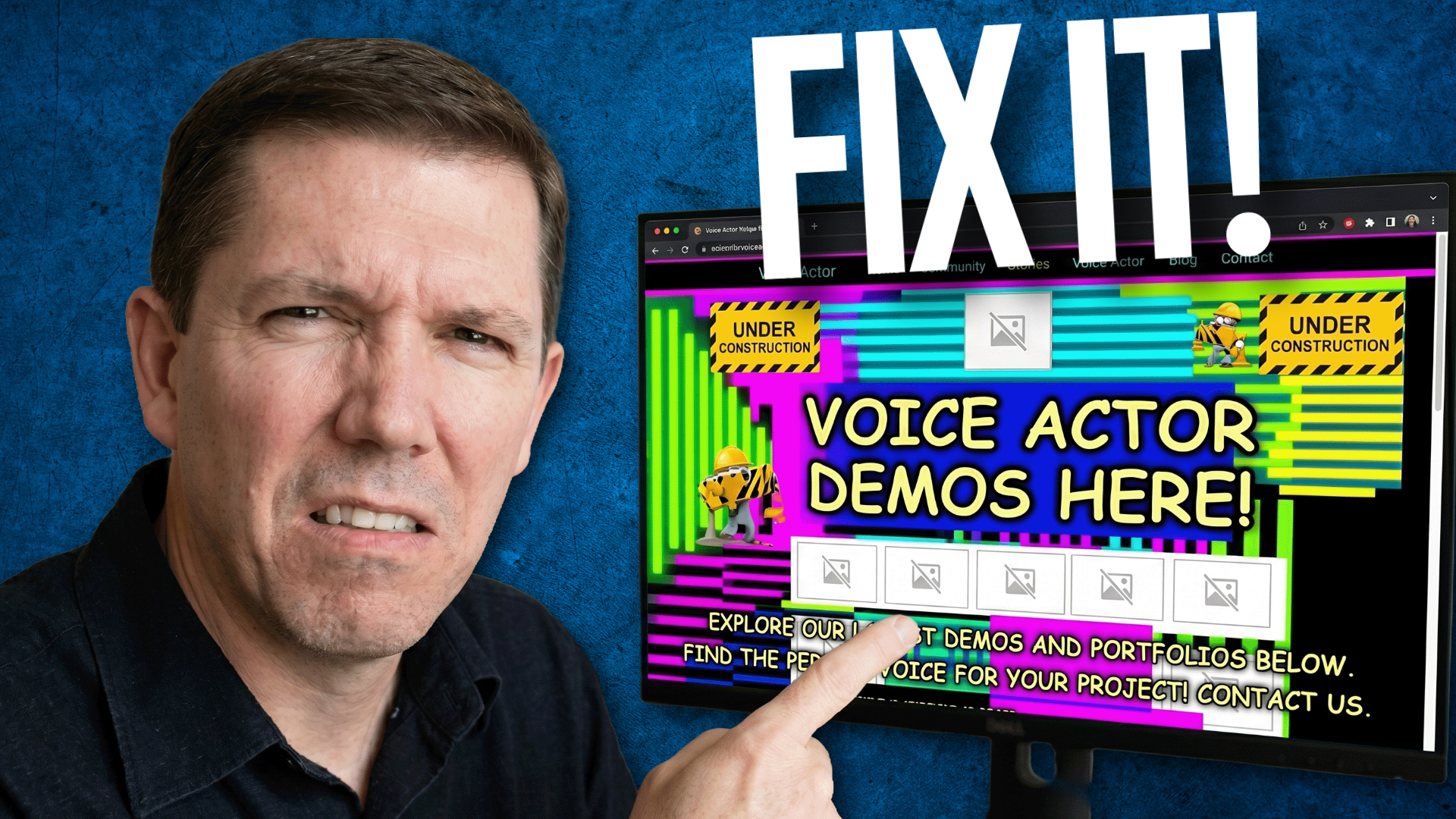
You might think you have a marketing problem.
You might think you need better outreach. Better SEO. Better demos. Better social media. Better casting site rankings. Better agents. Better luck. Better algorithms.

Whether you’re DIYing it or working with a pro, use our FREE guidebook to design a website that finally books you business. Click the image above.
Meanwhile, your website is sitting in the corner lighting opportunities on fire like a 3-year-old with a blowtorch.
Here’s the sad truth: most voice actor websites are not helping their careers. They are actively hurting them. They look hacky, confusing, outdated, self-indulgent, difficult to navigate, and/or painfully generic. And because voice actors stare at their own websites all day, they stop noticing the problems.
Clients do not.
The average producer, creative director, or project manager is not carefully analyzing your artistic journey while sipping coffee and admiring your branding choices. They’re busy. Distracted. Overworked. They have twenty browser tabs open and six deadlines breathing down their neck. They want one thing:
Can this person solve my problem quickly and professionally?
That’s it.
And if your website creates friction, confusion, or uncertainty for even five seconds, they’re gone.
This is one of the biggest mindset shifts voice actors need to make about voice over marketing. Your website is not an online résumé. It is not your digital diary. It is not a goddamned shrine to your precious creativity.
It is a sales tool designed to make it stupid-simple for clients to hear you, trust you, and contact you.
Most voice actor websites fail at all three.
So let’s talk about the ten most embarrassing voice over website mistakes sabotaging careers right now.
1. Your Demo Is in WITNESS PROTECTION
Nothing kills momentum faster than forcing people to hunt for your demos.
And yet voice actors do this constantly. They bury demos under dropdown menus, hide them on separate pages, or make clients scroll through giant walls of text before finding a tiny little play button that looks like it escaped from a 2009 WordPress theme.
Your demos are the product.
Not your bio. Not your inspirational quote. Not your carefully crafted welcome paragraph about your love of storytelling.
Your demos.
If a client lands on your site and cannot immediately hear your voice, your website has already failed the audition.
And let’s make this worse for a second: some voice actors still require downloads just to listen. Others have no way to download and file the demos. Others use broken players that don’t work on mobile. I see SoundCloud embeds filled with unrelated clutter and branding that pulls attention away from the actual talent.
You are making people work too hard.
The best voice actor websites make demo playback instant and obvious. One click. Done.
Because producers are not patient. They are flying through the hiring process.
2. Your Contact Process Feels Like a Mortgage application
You know what clients love? Convenience.
You know what they do not love? Email ping-pong.
A shocking number of voice actor websites still operate like it’s 2006. “Reach out for availability!” “Send me an email and I’ll get back to you!” “Let me know a few times that work for you!”
No!
Professionals use systems.
If a producer wants to connect with you, scheduling should feel easy like Sunday morning. A simple booking calendar instantly makes you look more organized, more established, and easier to work with. It removes friction and creates momentum.
Meanwhile, some voice actors still bury their contact forms in the footer like they’re ashamed of them. Others only provide social media links, which is the digital equivalent of saying, “Please DM into the void and hope for the best.”
Your contact process should scream, “Scheduling with me is super easy”
Not, “Maybe I’ll remember to check my inbox between auditions.”
3. Your Website Is a shrine to You
This one hurts people’s feelings. Good. Because it’s one of the biggest problems in voice over marketing.
Most voice actor websites read like autobiography projects. Endless paragraphs about childhood dreams, artistic passion, love of cartoons, and finding your voice. Meanwhile, the client is sitting there wondering whether you can actually help their project.
Clients care about themselves and their clients. That’s not rude. That’s just how business works.
They care about deadlines. Fast turnaround. Professional-quality audio. Reliability. Ease of communication. Whether you can make their explainer video sound human instead of robotic corporate dronespeak.
Your website should focus on the client’s problems you solve, not your emotional origin story.
There’s nothing wrong with personality. Personality matters. But your homepage is prime real estate, and too many voice actors waste it talking about themselves instead of speaking directly to user pain points.
A producer hiring for an eLearning project wants confidence that you can make dry material sound engaging. A commercial producer wants to know you can deliver clean audio quickly and take direction well. A corporate client wants reassurance that you’re professional and dependable.
That’s the shit that books.
4. Your Headshots Look Like mugshots
I see a lot of VO websites and I’m stunned and how many I see with cropped vacation photos, ancient LinkedIn headshots, or pictures that look like they were taken during a hostage negotiation.
Your photos matter.
No clients aren’t hiring you for your face but a big part of a professional image is visual. People make instant, conscious and unconscious judgments based on design, branding, photography, and presentation whether we like it or not.
A low-effort photo creates a low-effort impression.
And here’s the irony: voice actors will spend thousands on demos and coaching but use a profile pic that looks like it was taken with a disposable camera inside a Buc-ees.
Professional photography does not mean stiff and corporate. It means intentionality. Clear branding. Consistency. Images that communicate confidence, personality, and professionalism at the same time.
The best voice actor websites are cohesive. The photography matches the tone of the brand. Everything feels deliberate.
That level of polish builds trust fast.
5. Your Domain Name Screams “CHEAP-ASS!”
Nothing says “I’m not taking this seriously” quite like a domain name that looks free.
And yet we still see things like: bestvoiceguy247.wixsite.com, coolvoiceactor-va.net, and john-smith-voice-over.biz
Please stop.
A professional domain is one of the cheapest investments you can make in your business, and clients absolutely notice when you don’t have one. Weird domains, free subdomains, random hyphens, and awkward extensions immediately create doubt.
Your website should sound like a business.
Simple. Clean. Memorable. And if possible, get the .com.
Because the moment a client sees a free website domain, the next question is, “If they won’t invest in their own business, why should I?”
6. Your Website Looks Vanilla AF
This is where things get really ugly.
So many voice actor websites are clones of each other. Same stock microphone photos. Same “warm, conversational, authentic” buzzwords. Same generic, templated layouts.
It’s a sea of sameness.
Voice actors spend years trying to develop a unique sound, then build websites that look indistinguishable from everyone else in the industry.
Your website should reflect your brand, your positioning, and your personality. Not in some chaotic, over-designed way with spinning animations and 5 fonts. But in a way that actually feels distinct and memorable.
The strongest voice actor websites feel intentional. The copy has a point of view. The design choices support the brand. The personality feels real instead of manufactured.
You don’t need to look outrageous. You just need to stop looking forgettable.
7. Your Website Is a Mobile Disaster
Here’s a terrifying thought: A huge percentage of your traffic is probably visiting your website on a phone. On my own sites, it’s about 25%.
Now imagine what happens when your demo player breaks on mobile. Or your buttons overlap. Or your text becomes microscopic. Or your contact form refuses to work properly. Or your video demo takes a minute and a half to load over cellular data.
That’s not a minor inconvenience. That’s lost work, because people won’t wait, or work through the issues. They’ll just leave.
Voice actors sometimes obsess over tiny branding details while completely ignoring usability. Meanwhile, producers are rage-quitting their sites because they can’t even press play properly on an iPhone.
Mobile optimization is not optional anymore. Your website should work beautifully on every device. Fast loading. Clean layout. Functional demo playback. Easy navigation. Obvious contact options.
8. You Have Zero Social Proof
This is one of the fastest ways to make your website feel minor league.
No testimonials. No client logos. No recognizable brands. No reviews. No proof anybody has ever trusted you before.
You’re basically asking strangers to gamble on you with zero reassurance.
And look, if you’re newer, that’s understandable. Everybody starts somewhere. But even then, there are strategies to address that - check out this video here. But too many established voice actors still neglect this stuff completely. Meanwhile, testimonials are one of the most powerful trust-building tools in all of marketing.
People trust what other people say about you far more than what you say about yourself.
Even short testimonials can dramatically improve credibility. A quick quote about professionalism, turnaround speed, communication, or performance quality helps reduce uncertainty. Client logos reinforce legitimacy. Industry memberships add authority.
Without social proof, your website feels like you’re making claims in a vacuum.
And in voice over marketing, trust is currency.
9. Your Website Has No Clear Call to Action
This one destroys conversions every single day. A client reaches the bottom of your homepage and thinks, “Okay… now what?”
That’s no bueno.
Your website should guide people toward action. Request a quote. Schedule a call. Contact you. Listen to demos. Something.
Anything.
Instead, many voice actor websites end with vague inspirational bullshit and no clear next step whatsoever. The visitor is left wandering around trying to figure out what you actually want them to do.
Never make clients think harder than necessary.
Strong calls to action create momentum. Weak calls to action create hesitation. Hesitation kills inquiries.
This is one of the most overlooked voice over website tips out there. Your website shouldn’t just exist; it should strategically move visitors toward contact, conversion, and connection.
Otherwise, it’s just expensive digital decoration.
10. You Built a Website Instead of a Marketing Tool
This is the big one. The root problem underneath almost all of these mistakes.
Too many voice actors build websites based on what they personally like instead of what actually helps clients hire them.
That’s how you end up with confusing menus, cluttered layouts, giant blocks of self-focused copy, autoplay videos, unnecessary animations, and distractions.
The best voice actor websites aren’t the fanciest. They’re the clearest.
They remove friction. They reduce uncertainty. They make demos easy to hear. They make contact effortless. They make professionalism obvious.
That’s what effective voice over marketing actually looks like.
Your website is not there to impress other voice actors. It’s there to make clients feel confident enough to hire you. That’s the mission.
Your Website Is Probably Costing You More Work Than You Think
Here’s the part most voice actors never consider: clients don’t tell you your website was the problem.
They don’t email saying, “Hey, just so you know, your mobile layout was a disaster and your demo player broke on my phone.”
They just move on.
That’s why website problems are so insidious. They create invisible leaks in your business. You blame the market, the economy, casting sites, AI, or industry slowdown, while your website is standing in the corner drop-kicking opportunities into traffic.
And that should be encouraging, because this shit is fixable.
You do not need a $5,000 custom website. You do not need perfect branding or six months of obsessive tweaking. You need clarity, professionalism, usability, and a client-focused approach.
That’s it.
A strong voice actor website should make hiring you feel easy. Fast. Low-risk. Professional. If your website does that well, your marketing becomes dramatically more effective.
If it doesn’t, no amount of social media posting is going to fully compensate for the friction you’re creating.
So pull up your site and look at it honestly. Not as the emotionally attached artist. As the client.
Can people hear your demos immediately? Can they contact you effortlessly? Does your site work beautifully on mobile? Does it feel trustworthy? Does it look like a real business? Does it stand out? Does it clearly explain why someone should hire you?
Or does it suck?
Because if it does, now you know where to start.