Local VO Work vs P2P Online Casting Sites: Which Is Better?
If you’re relying on online casting sites to build your voiceover career, you’re probably running in circles, and it’s costing you time, money, and energy.
The Trap of the Online Casting Platforms
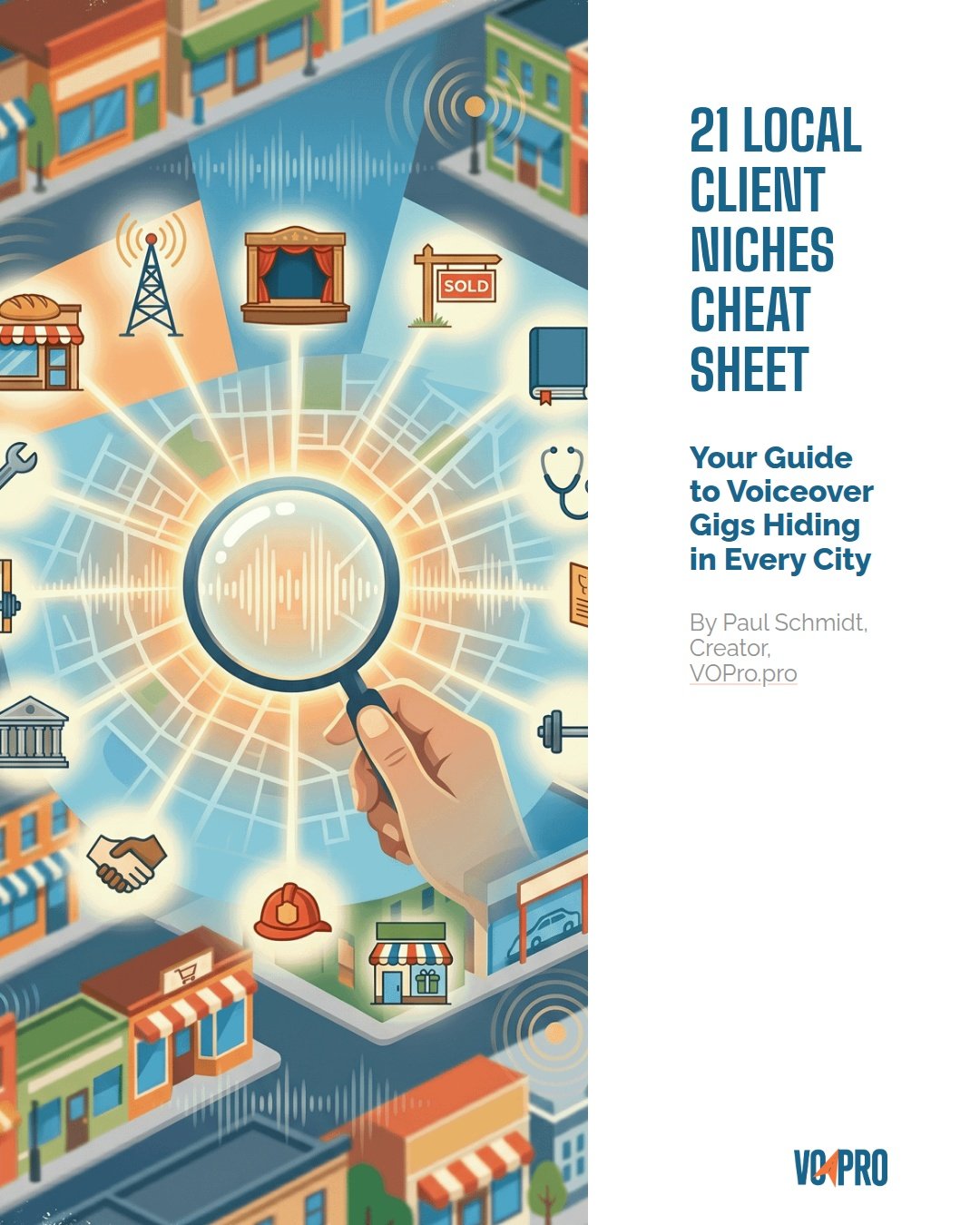
Get my free 21 Local Niches Cheat Sheet. Click the image above.
Every voice actor has been there: sign up for a pay-to-play (P2P) casting site, set your prices, crank out the auditions, then… wait. Maybe you’re auditioning for ten gigs a day, maybe you’re doing a hundred, couple of hundred a month, riding the roller coaster of hope and disappointment as booked gig emails rarely hit your inbox.
It’s easy to believe that online casting platforms (pay-to-plays or P2Ps) are your golden ticket. After all, everybody seems to be doing it, right? The sites are full of thousands of other actors, packed with job postings, and promise access to thousands of clients.
In reality, it can feel more like a lottery, and the odds rarely tip in your favor, especially when you’re new.
Let’s talk about the real choices you face as a VO talent, and why the road less traveled just might change your career.
The P2P Online Casting Boom and Its Hidden Costs
How These Sites Hook You
The pitch is seductive: “Pay a yearly fee, audition for unlimited jobs, and get work from clients all over the world.” For a lot of voice actors, especially those just starting out, it seems like a straightforward equation: more auditions equals more work.
But here’s what P2P sites don’t tell you:
Competition Is Insane. For every job posted, there may be hundreds of auditions, often within hours. Quick fingers get the first spots; slower actors are left sending auditions into the abyss. Many don’t even get listened to. And if you don’t book early, it can be a algorithmic death spiral
Rates Are Set (and Low). Many clients on these platforms are shopping for cheapest voice, not best voice. Low balling is rampant, with actors underbidding each other for $50 a holler.
Zero Relationship-Building. The platform acts as a wall between you and the client. You’re a hired gun, not a partner.
Platform Dependency. The moment you stop paying, your access to jobs evaporates. And when, not if, the site’s algorithms change, you could be invisible overnight. It’s already happened to scores of really good voice actors multiple times.
Why the Cycle Is Hard to Break
One voice actor I personally know started as a part-timer, auditioning mornings before their day job. At first, it was thrilling, looking for voice acting jobs online, feeling like each audition was a chance to book a VO gig.
But weeks turned into months, and the only jobs they booked paid garbage rates. They got used to losing and felt stuck. Without a marketing system of their own, their entire business rested on a single platform’s rules and whims.
Local Voiceover Jobs: The Path Hiding in Plain Sight
The Overlooked Goldmine Close to Home
Meanwhile, a different world of opportunity exists all around you. Local businesses, agencies, non-profits, schools, city governments, and regional media outlets all need voices.
Most have never posted those jobs on a giant casting site. They’re eager for help but so often want real partners, not one-and-done hired guns.
These gigs often pay better, have way less competition, and come with a deeper sense of connection and repeat business than most faceless online gigs could.
Online vs. Local: What’s Really at Stake?
Earnings Potential: The Numbers Don’t Lie
Let’s break this down. While rates vary:
Online P2P Sites: Many gigs often pay $50–$150, sometimes less, after the site takes a cut. Good jobs do exist but are fiercely competitive, both in terms of the volume of competition and the urgency of getting the auditions in asap so they have at least a shot at getting listened to.
Local Jobs: Even small businesses may pay $250–$800 per spot, and clients with repeat needs (schools, agencies, video producers) can become recurring partners and great sources for more steady income.
Fact: The odds of booking repeat business from a local client or getting referrals skyrocket when you build a strong, personal connection.
Authority & Relationships: The Hidden Currency
Online, you are a commodity. You’re just another name on a list. Locally, you can become the go-to voice for an agency, tourism board, or retail chain. That leads to:
Less auditioning for every job (you often get direct invites)
More creative freedom (fewer “cookie-cutter” requirements)
The ability to appropriately raise rates as your business and performance skills grow
The Partial Myth of More Auditions = More Bookings
Online casting platforms train you to believe that auditioning more automatically leads to more paid jobs. Not always. The P2P audition treadmill can burn talent out fast.
Local outreach, on the other hand, is about quality - building relationships, being top-of-mind and easy to work with, and solving specific business problems for real people.
How to Find Voiceover Clients Without Being Pushy or SpammY
The Direct Outreach Method
Finding local voice over clients doesn’t mean random cold-calling. Here’s a practical, non-icky way to start:
1. Make a Hit List
Research local production companies, marketing agencies, radio/TV outlets, schools, and non-profits.
Use Google Maps, LinkedIn, and simple searches: [city] + “video production,” [city] + “advertising agency,” etc.
2. Craft a Killer Introduction
Skip the generic mass email. Write a brief, personal note. Focus on the prospect’s problems, challenges and pain points.
Reference a recent project if you can find one. Example: “I loved the energy in your latest campaign for Dave’s Hardware. I specialize in warm grounded reads, perfect for future spots like yours.”
3. Show a Taste of Your Talent
Share your demo, highlight your style, and make it easy for them to listen and download (so they can file and find you when the time comes for a project).
4. Follow Up Sparingly
If you don’t hear back, a soft follow-up a week later is fine. Keep it warm and helpful, not pushy.
5. Let Your Personality Shine
Local businesses value connection. Show who you are add a friendly, professional photo, mention your favorite local coffee shop, a community tie-in, or better yet, a mutual connection.
Niche Down Even Further
Some voice actors explode their local business by focusing on specific niches: “I’m the go-to narrator for real estate videos in Denver,” or “I‘m the voice of Local Client XYZ.”
This makes you instantly memorable.
Bridging the Worlds: Can You Do Both?
Here’s the truth: almost every successful full-time voice actor started with both local and online jobs. But the difference is how you use each:
Treat P2P platforms as but one client acquisition strategy of many, not your whole business plan.
Use any early earnings to invest in local outreach, better demos, and your own marketing (website, LinkedIn, email tools).
Diversify your sources of work so no single algorithm, platform, or even a single client can threaten your business.
7 Strategies to GO Full-Time in VO Faster
Audit Your Weekly Time. How many hours go to unsuccessful auditions vs. relationship-building? Where are the distractions and time leaks? Shift the balance. Need a hand?
Upgrade Your Website. Make a local page. Mention your city, local clients you work with, and include testimonials from real local folks.
Build a Referral Engine. Every time you finish a job, ask: “Who else do you know who uses voice talent?”
Join Local Networks. Attend chamber of commerce, marketing meetups, or ad club mixers. Get visible in your area.
Use Social Proof. Post finished work on LinkedIn with context: “Honored to help Springfield Food Bank launch their new campaign!” with a one-line testimonial.
Invest in VO Marketing Training. Take programs or coaching built on direct client outreach like the VO Freedom Master Plan™ Building your own marketing skill will last beyond any algorithm change.
Track Everything. Know your booking rate, and conversion rate (contacts made to clients acquired). Double down on what works. Thorw out or tweak what doesn’t.
The Real Game-Changer: Mindset Shift
Transitioning to full-time or levelling up your success in voiceover is not about chasing jobs it’s about attracting partners by being visible, memorable, and indispensable in your market. Online casting sites can be part of your toolkit, but when you master local and direct marketing, you own your destiny.
Don’t Let Fear Hold You Back
Fear keeps most actors glued to P2P sites. It feels safer to follow the crowd. But real security comes from diversifying your client base and building real relationships.
You don’t need to go viral. You need to become a fixture in the places where real clients already are: at home, at work, in your community.
Next Steps: Start Small, Think Big
If this feels overwhelming, remember: Every full-timer started with a single local email, one coffee shop, or their friend’s startup ad. Start with your neighborhood, then expand.
Want more support finding local voiceover jobs? My VO Local™ crash course and VO Client Connect Plus™ tool were built for this. You’ll learn direct, proven strategies to find and keep great clients without working for peanuts online.
And if online casting is still part of your plan? Use it as a screwdriver, not the whole toolbox.
Stop letting the casting sites dictate your voiceover future. Build a business where the work finds you.