Does Direct Marketing Still WORK for Voice Actors?
You can spend a whole afternoon reading predictions about the future of voice over and finish with absolutely no fucking clue what to do the next morning.
Depending on which post you read, you need better acting, better SEO, another casting subscription, or a completely different career.
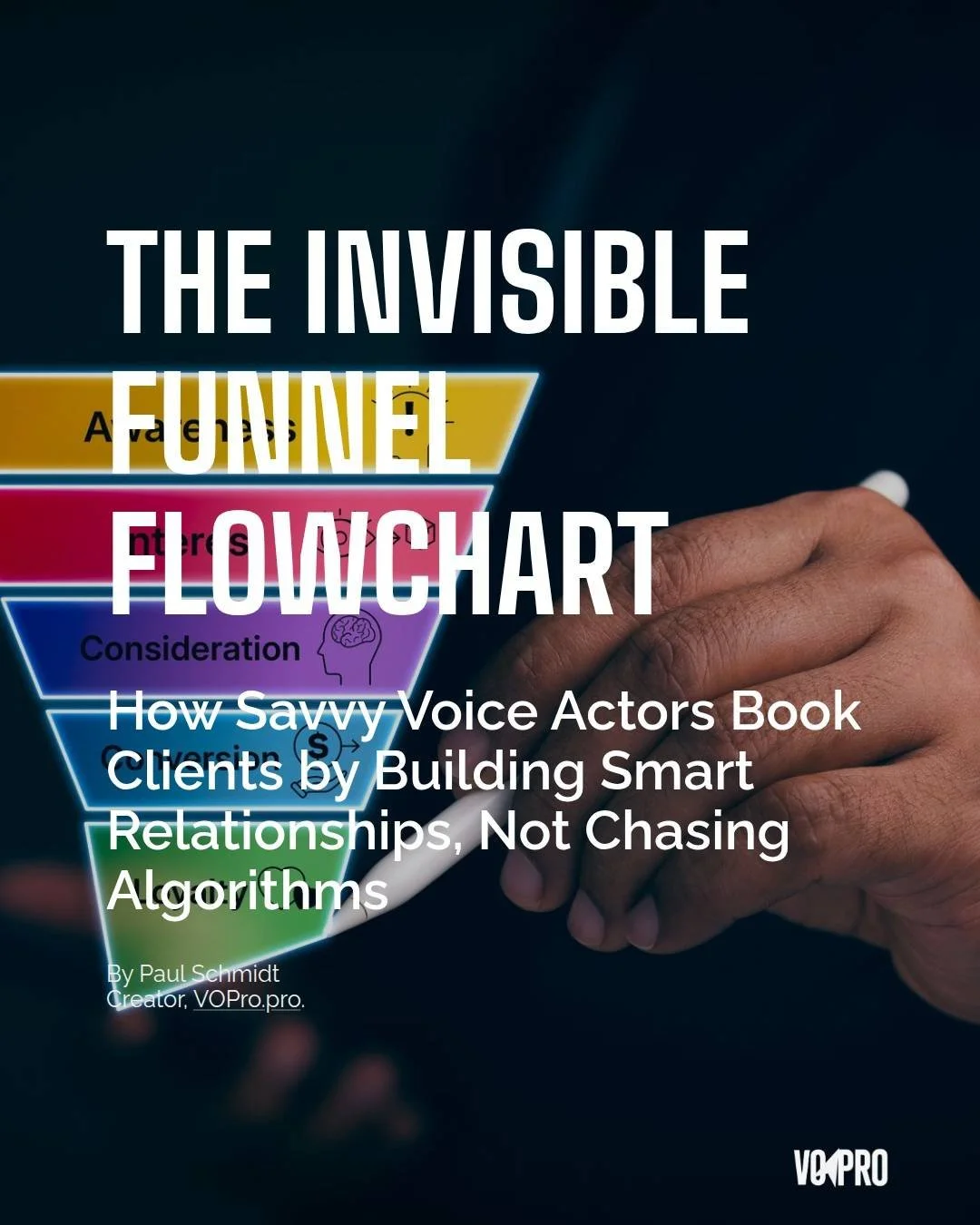
Get our free Invisible Funnel Flowchart and move beyond cold pitches and start booking real gigs through genuine relationships.
Meanwhile, the next morning comes and your mortgage doesn’t give a goddamn about your reading material.
Two recent blog posts offer something more helpful than another round of industry panic.
Tom Dheere’s “The AI Voice Over Disruption”” looks at changing work patterns and questions the effectiveness of conventional direct marketing.
J. Michael Collins’ ““The Great Voiceover Realignment: VO in 2030” discusses how relationships and AI-assisted search might shape future hiring.
I respect both of these guys a ton. They’ve been doing this longer than I have and their perspectives always deserve consideration, and I encourage you to read both pieces.
They’ve prompted me to talk about why I believe direct marketing remains an invaluable part of a voice actor’s business, especially when the market is changing.
My position starts with something we can actually do: identify buyers whose needs fit our skills, introduce ourselves with relevance and value, and earn their trust over time. We can improve that process while also improving our craft and making ourselves easier to find.
Tom’s emphasis on stronger acting is on-point. Marketing gets you considered; your performance and professionalism have to justify that consideration. JMC’s emphasis on clear positioning is equally helpful. Buyers need to understand where you fit and see evidence that you can deliver.
Those ideas belong together. A producer needs both a capable actor and a way to discover that actor. Direct outreach gives us one way to make the connection.
What the Numbers Actually Tell Us
Before talking tactics, though, we need to be honest about what the evidence tells us.
The 2026 Voice Crafters survey reports that 73.9% of respondents to its AI job-loss question believed they had definitely or probably lost work to AI. Separately, 71.8% of those answering its rates question said their rates had stayed flat or increased over three years. The study used a self-selected sample, which its methodology acknowledges.
Those findings deserve attention. They also show why a stable rate card can coexist with a painful drop in income. Charging the same amount per project doesn’t help much when fewer projects arrive.
But these figures don’t test direct email marketing or establish which prospecting approach produces the best results. They describe the respondents’ experiences with work and rates. We need to avoid asking that evidence to answer a different question.
Tom also cites an Apollo guide reporting increased sales email volume alongside declining reply rates. That is a legitimate reason to question the assumption that sending more messages automatically generates more business.
The surrounding guide is useful context. Apollo recommends adapting outbound sales around research, relationships, multiple channels, and measurement. They warn against excessive automation and indiscriminate volume. Apollo sells outreach software, so it has a commercial interest here, and its observations about sales teams aren’t voiceover-specific benchmarks.
In transparency, we use and teach Apollo in the VO Marketing Master Plan, and we also warn against too much automation and volume for volume’s sake.
Still, there is a big difference between evidence of declining average response and evidence that a channel can no longer produce worthwhile business. Averages alone can’t tell an individual voice actor whether their particular approach is worth the time.
We have to look at the approach.
Give the Buyer a Reason to Care
If you download a giant list, introduce yourself as a passionate and versatile voice actor, attach everything you’ve ever recorded, and keep asking whether anybody has work, you have given yourself plenty to do.
But you haven’t given the prospect a reason to give a damn.
That’s where direct marketing begins for me: the reason to contact this particular business. Does it produce work that uses voice over? Who handles that work? Does it hire independent talent? Can you deliver something relevant to its projects and expectations?
An email address in Apollo answers none of those questions by itself. A contact database can help you locate people. You still have to decide whether approaching them makes business sense.
Imagine a production company whose portfolio includes patient education videos. If medical narration is a real strength of yours, you have a plausible reason to introduce yourself. You can point to relevant work and make it easy to hear how you handle complex information.
Now imagine sending that same producer a sprawling introduction covering animation, automotive, audiobooks, live announcing, and your lifelong love of funny voices. Everything might be true. You’ve still handed them the job of figuring out why any of it matters to their production.
Relevant outreach reduces that work. The buyer can quickly and easily understand what you offer, the problem you solve, why you contacted them, and whether taking the next step is worthwhile.
This is also why personalization needs substance. Mentioning somebody’s college or congratulating them on a LinkedIn anniversary doesn’t establish professional relevance. Understanding what they produce, what problems they face, the challenges they deal with, and what keeps them awake at night gives you a much better starting point than demonstrating that you found their profile.
Direct outreach also lets you choose where to invest your attention. You can research a particular industry, production specialty, geographic market, or type of buyer, then adjust based on what you learn.
That flexibility matters when demand shifts. If a segment or genre is consistently telling you it has moved suitable projects to synthetic voices, sending the same pitch more often won’t reverse those production decisions. You need to reconsider the opportunity, your positioning, and/or the buyers you’re pursuing.
No genre label guarantees protection from AI. Evaluate actual companies and actual projects. Look for situations where your performance, judgment, collaboration, and reliability have a credible role in the buyer’s outcome.
A relationship won’t make you immune to budget cuts or technological change. It can, however, give you a chance to understand a client’s priorities and demonstrate value beyond the fact that you have vocal cords and an internet connection.
Their Production Calendar Doesn’t Follow Your Goals
We also need realistic expectations about timing. A producer can think you’re a good fit and have absolutely nothing to hire you for this quarter. Their production calendar did not receive a copy of your revenue goal, not does it care.
In a recent VO Pro Community digest, a member reported their first warm lead after three weeks of consistent email outreach and said they had joined the prospect’s contact list. That is a modest, specific example of movement from an introduction toward consideration.
It isn’t evidence of a paid booking, and I won’t inflate it into one. It does illustrate why we should recognize intermediate progress (what we call Wins) while continuing to track whether that progress eventually becomes business.
A reply, a request for samples, or an invitation to stay in touch can be useful wins. None pays the bills on its own. The point of tracking those steps is to understand where opportunities advance, where they stall, and what deserves further attention.
Follow-up belongs in that process, with judgment. A relevant sample, an update connected to the prospect’s work, or a check-in at a time they suggested can provide a reason to reconnect. Repeatedly demanding a response because your sequence says it’s touch number seven is a shitty experience for the prospect.
Respect a no. Respect communication preferences. And recognize when continued pursuit is eating up time that would be better spent elsewhere.
Persistence requires decisions, not just a calendar reminder.
Busy Ain’t the Same as Profitable
I built my voice over business through direct email outreach. That experience shapes my perspective, but it doesn’t excuse me from evaluating present results. I teach direct marketing, too, so I have a responsibility to examine it honestly rather than defend every tactic somebody associates with it.
We should ask which prospects produce relevant conversations, which conversations become opportunities, and which opportunities become profitable clients. We should account for research and follow-up time. A process that keeps you busy without producing worthwhile business needs adjustment.
And if you're struggling, that doesn't automatically mean your marketing is bad. Good actors with thoughtful approaches can encounter weak demand, established vendor rosters, bad timing, or projects that never get funded. We need to leave room for those realities instead of turning every disappointing result into a personal failure.
It’s almost always NOT about you.
The practical response is diagnosis. Check whether your messages are reaching people (deliverability), whether those people hire what you offer (relevance), and whether your demos support your case. Look for patterns across your efforts. Sometimes the next move is better outreach. Sometimes it's a different market segment, stronger skills, or a different source of work. Your business will benefit from that honesty.
That measurement should extend beyond the first invoice. A client may hire you once, repeatedly, or introduce you to another buyer. Those outcomes have different value, and understanding them helps you make better decisions about where to focus.
Be careful with attribution, too. Someone might receive your email, visit your website, hear about you from a colleague, and contact you months later. Ask how they found you and what prompted them to reach out. Real buying journeys can be messier than the neat little boxes in your tracking system.
Be Easy to Find. Keep Making Introductions.
That brings us to JMC’s argument about discoverability. His recommendation to make your expertise clear and support it with evidence is something I strongly support. Relevant demos, credible experience, and helpful information help buyers evaluate you.
Google’s guidance on AI search features says that established SEO practices remain relevant and that appearing in AI Overviews or AI Mode doesn’t require special additional optimization. That guidance concerns Google’s systems specifically, but it reinforces the value of a useful, accessible website.
You should be investing in that. Give a prospective client enough information to understand your work, hear relevant examples, and contact you without hunting all over your website to find out how.
JMC also offers a hypothesis that, by the early 2030s, perhaps 90% of work outside the agent and casting ecosystem could find talent through inbound discovery. He clearly acknowledges uncertainty. I’d treat that as a possibility to prepare for rather than a forecast around which to give up on proactive relationship building
If discovery improves dramatically, a strong online presence will serve you well. If discovery remains uneven, you’ll still benefit from relationships you initiated yourself.
Building both gives you more ways to create opportunity while the future unfolds.
It also recognizes that actors start from different positions. Someone with shitloads of credits and established visibility has different assets from someone building their early client base. Both can strengthen their discoverability. The newer actor also needs practical ways to introduce themselves while those assets and cred develop.
These activities can support one another. Your email gives a suitable buyer a reason to visit your website. Your website provides evidence. A conversation helps clarify fit. Good work can lead to repeat business, referrals, and testimonials that strengthen future introductions.
You don’t need to declare loyalty to a single marketing channel. Use direct outreach alongside appropriate casting opportunities, representation, networking, referrals, and client care. Choose a manageable combination based on your skills, your market, and the results you can actually observe.
What to Do The Next Morning
For your next working week, start with one buyer category you understand or are prepared to research. Identify a small group of plausible prospects. Review their work, identify the relevant people, and write a concise introduction that makes your fit easy to assess.
Then check the page or sample you’re sending them to. Does it support the introduction? Can they quickly hear the relevant work? Is the next step clear? Outreach and your online presence should tell a consistent story.
Record what happens and schedule reasonable follow-up. Give the process enough time to produce useful information, while staying willing to revise your targeting or message. The goal is to learn which activities deserve continued investment.
That’s the thinking behind Target, Reach Out, Grow in The VO Pro Marketing Master Plan™: develop a repeatable way to identify suitable clients, begin conversations, and build relationships you can serve well. The tools can change. Your approach should keep responding to what buyers need.
If you’d like help putting that into practice, explore The VO Marketing Master Plan™ and join the waitlist.
We can take the industry’s changes seriously and keep building successful businesses within and despite those changes. Tomorrow morning still gives you a chance to make relevant, value-driven introductions.